


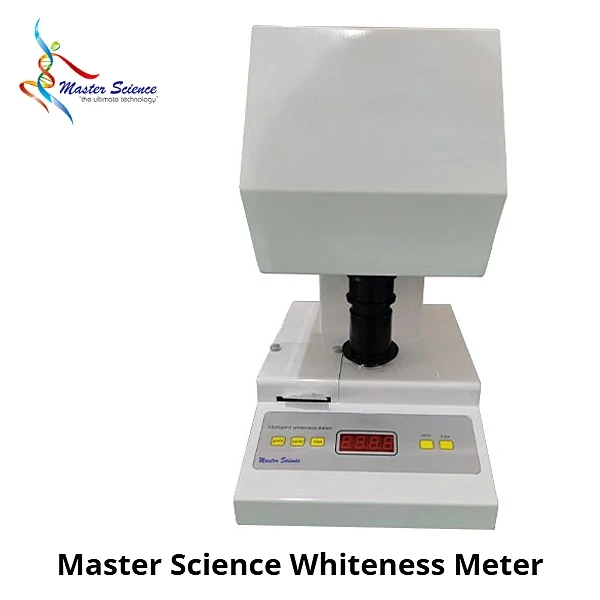
Whiteness Meter - Digital Whiteness Tester for Powder and Paper - 0-100 Range - d/0 Geometry
Inhouse product


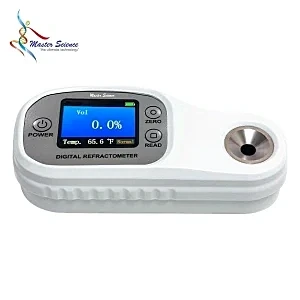
The Master Science Whiteness Meter measures the whiteness of powders and flat materials by diffuse reflection. It is used for flour, starch, rice flour, salt, textiles, chemical fibre, plastics, porcelain clay, talc, white cement, paint, ceramics, enamel, paper and pulp.
The optics follow the d/0 geometry, diffuse illumination with perpendicular viewing, under simulated D65 light. A reading takes two seconds, and a light absorber removes the effect of specular reflection.
Technical Specifications
Specifications of the Master Science Whiteness Meter:
- Brand: Master Science
- Model Number: MSWHT-VSWISS
- SKU: MSWHT-VSWISS
- Brand: Master Science
- Model Number: MSWHT-VSWISS
- SKU: MSWHT-VSWISS
- Measurement Range: 0 to 100
- Measurement Method: Reflection
- Illumination Geometry: d/0
- Integrating Sphere Diameter: Φ120 mm
- Measuring Aperture: Φ20 mm
- Repeatability: ≤0.1
- Indication Drift: ≤0.1
- Zero Drift: ≤0.1
- Indication Error: ≤0.5
- Measurement Time: 2 seconds
- Light Source Life: Up to 100,000 hours
- Display: LED
- Working Environment: 0 to 40 °C; <80% RH
- Electricity: AC 220 V ±22 V, 50 Hz
- Gross Weight: 9.5 kg
- Shipping Dimensions: 320 × 400 × 480 mm
Key Benefits
- Suitable for the production floor: the Master Science Whiteness Meter has a fully sealed design.
- Fast checks: two seconds per measurement.
- Consistent numbers: repeatability within 0.1.
- Little maintenance: light source rated for 100,000 hours.
- Easy calibration: one-key zero and digital white-board calibration.
For full colour measurement, see the Master Science portable colorimeter.
Product Features
Optics
- Diffuse illumination, perpendicular viewing (d/0)
- Simulated D65 illuminant
- Light absorber against specular reflection
Control
- Microcomputer control with touch keys
- Embedded operating system
- Fast digital algorithm
- Calibration parameters saved automatically
Design
- Fully sealed housing
- Energy-saving long-life light source
- Automatic calibration
Applications
The Master Science Whiteness Meter is used for:
- Flour, starch, rice flour and salt
- Printing, dyeing and chemical fibre
- Plastics, paint and white cement
- Porcelain clay, talc, ceramics and enamel
- Paper and pulp
Common Problems and How This Meter Helps
How the Master Science Whiteness Meter supports quality control:
- Visual grading that varies by person: numeric whiteness from 0 to 100.
- Dust entering the optics on site: sealed construction.
- Gloss distorting readings: light absorber removes specular light.
- Frequent lamp replacement: 100,000-hour light source.
Frequently Bought Products
"Explore Master Science, your trusted provider of high-quality laboratory equipment and innovative solutions. Discover our extensive range of analytical instruments and exceptional customer support, all dedicated to empowering scientific discovery across industries. Join us in advancing research and setting new standards globally."


