


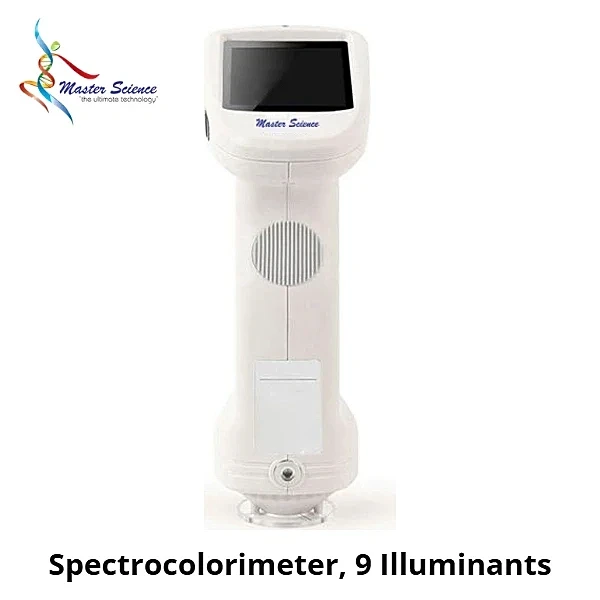
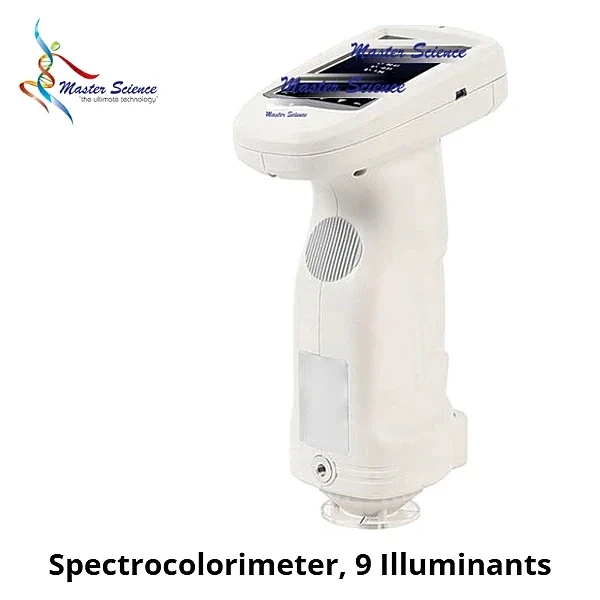
Spectrocolorimeter - Handheld Color Analyzer - 400-700 nm - 9 Illuminants SCI/SCE
Inhouse product


The Master Science Spectrocolorimeter is a handheld color spectrophotometer for precise color measurement and quality control on plastics, coatings, inks, textiles, printed goods, ceramics and fluorescent samples. A dual optical path captures SCI and SCE spectra together, with optical resolution better than 10 nm across the visible range.
Nine illuminants, two observer angles and a wide range of color spaces and indices let one instrument meet the standards used by different customers and industries.
Technical Specifications
Technical specifications of the Master Science Spectrocolorimeter:
- Brand: Master Science
- Model Number: MSSP-CLR760SWISS
- SKU: MSSP-CLR760SWISS
- Optical Geometry: di:8° / de:8°, SCI and SCE, UV excluded
- Standards: CIE No.15, GB/T 3978, GB 2893, GB/T 18833, ISO 7724-1, ASTM E1164, DIN 5033 Part 7
- Integrating Sphere: Ø40 mm
- Light Source: Combined full-spectrum LED
- Spectral Method: Flat grating (1000 lines, blazed)
- Sensor: Silicon photodiode array, dual row of 40
- Wavelength Range: 400 to 700 nm
- Wavelength Interval: 10 nm
- Half Bandwidth: 10 nm
- Reflectance Range: 0 to 200 %
- Measuring Aperture: One aperture: MAV Ø8/Ø10 mm or SAV Ø4/Ø5 mm
- Color Spaces: CIE LAB, XYZ, Yxy, LCh, CIE LUV, sRGB, βxy, Munsell (C/2)
- Color Difference Formulas: ΔE*ab, ΔE*uv, ΔE*94, ΔE*cmc (2:1, 1:1), ΔE*00
- Other Indices: Whiteness, yellowness, staining and color fastness, color strength, opacity, 8° gloss
- Observer: 2° / 10°
- Illuminants: D65, A, C, D50, F2 (CWF), F7 (DLF), F10 (TPL5), F11 (TL84), F12 (TL83/U30)
- Measurement Time: About 1.5 s (SCI and SCE about 3.2 s)
- Repeatability: Reflectance SD within 0.1 %; ΔE*ab within 0.04
- Inter-instrument Error: ΔE*ab within 0.2 (12 BCRA Series II tiles)
- Measurement Modes: Single or average of 2 to 99
- Positioning: Camera locating and stabilizer cross position
- Battery: 3.7 V 5000 mAh Li-ion, 6000 measurements in 8 hours
- Lamp Life: 5 years, more than 3 million measurements
- Display: 3.5-inch TFT color capacitive touchscreen
- Data Port: USB
- Storage: 1000 standards, 20,000 samples
- Dimensions (L × W × H): 129 × 76 × 217 mm
- Weight: About 600 g
Key Benefits
- Excellent agreement between units: ΔE*ab within 0.2 between instruments supports supplier and multi-site QC.
- Store-lighting checks: nine illuminants, including TL84 and CWF, reveal how a color shifts under retail lamps.
- Two readings in one: the Master Science Spectrocolorimeter measures SCI and SCE together in about 3.2 seconds.
- Exact positioning: camera locating and a cross stabilizer place the aperture precisely.
- Long working day: one charge covers about 6000 readings.
For more compact daily checks, compare with the Master Science portable spectrocolorimeter with camera targeting.
Product Features
Optics
- Dual optical path for simultaneous SCI and SCE
- 1000-line blazed grating
- Large-area silicon photocell array
- Switchable flat or tip measuring aperture
Software and Data
- Spectrogram, chromaticity and color difference graphs
- Pass/fail and color offset
- 20,000 sample memory
- USB link and PC software
Handling
- 3.5-inch true-color capacitive touchscreen
- Stain-resistant white calibration board
- Ergonomic handheld body
Applications
The Master Science Spectrocolorimeter is used for:
- Plastics and electronic components
- Paints, coatings and inks
- Textile printing and dyeing
- Printing and packaging
- Ceramics and fluorescent materials
Standard Accessories Included
- Power adapter
- User guide
- PC software
- USB cable
- White and black calibration cavity
- Protective cover
- Wrist strap
- One measuring aperture (8 mm or 4 mm)
Optional Accessories
- Micro printer
- Powder test box
Common Color Control Problems and How This Instrument Helps
Problems the Master Science Spectrocolorimeter helps to solve:
- Color looks different under shop lights: nine illuminants show the shift before shipment.
- Disagreement with supplier readings: low inter-instrument error keeps values aligned.
- Gloss affecting color decisions: SCE and SCI are reported side by side.
- Small parts hard to measure: 4 or 5 mm apertures fit narrow areas.
- Slow documentation: USB transfer and PC software speed up reports.
Frequently Bought Products
"Explore Master Science, your trusted provider of high-quality laboratory equipment and innovative solutions. Discover our extensive range of analytical instruments and exceptional customer support, all dedicated to empowering scientific discovery across industries. Join us in advancing research and setting new standards globally."


