


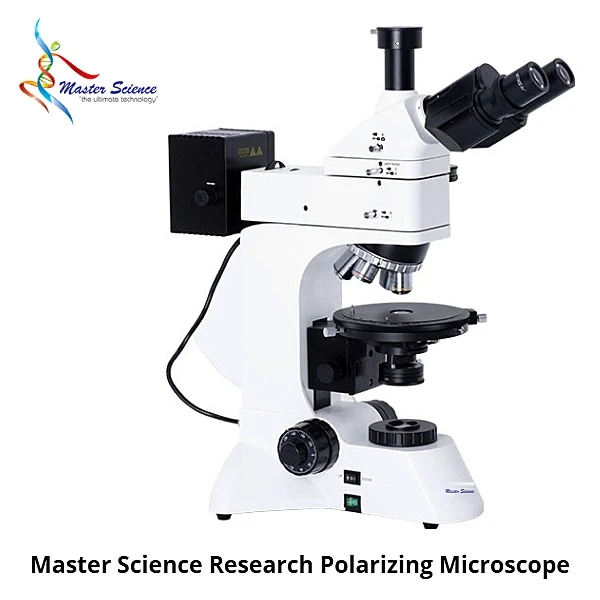
Research Polarizing Microscope - Trinocular Reflected and Transmitted Light - 5X-60X, 6V/30W Halogen
Inhouse product


The Master Science Research Polarizing Microscope uses an infinity optical system in a modular stand that carries both an epi-illumination system and transmitted illumination. Its objectives are infinity-corrected, strain-free and long working distance, which is what polarized light measurement requires.
A push-in Bertrand lens, three compensators and a graduated rotating stage with 6′ vernier make the Master Science Research Polarizing Microscope suitable for research and inspection in geology, chemical engineering, medicine and pharmaceuticals. It also handles crystal phase observation of liquid polymer materials, biopolymers and liquid crystal materials.
Technical Specifications
Specifications of the Master Science Research Polarizing Microscope are given below.
- Brand: Master Science
- Model Number: MSMSC-P41MSWISS
- SKU: MSMSC-P41MSWISS
- Optics: Infinity optical system
- Observation Tube: Tilting trinocular, split ratio 100:0 or 0:100
- Viewing Head: Siedentopf head, inclined at 30°
- Eyepiece: WF10X/22 mm; reticule eyepiece 10X/22 mm (graduation 0.1 mm/div.)
- Objectives: Infinity PL L5X/0.12, W.D. 26.1 mm; polarizing objectives 10X, 20X, 60X
- Nosepiece: Inward-facing quadruple nosepiece, ball-bearing positioning
- Focusing: Coaxial coarse and fine focusing with adjustable coarse tension and limit locking device; fine graduation 2 μm
- Stage: Mechanical X-Y rotating stage, Φ150 mm; 360° graduations; vernier scale 6′; centre-adjustable with locking device
- Epi-illumination System: 6V/30W halogen lamp, adjustable brightness; built-in field and aperture diaphragms; filter changer (yellow, blue, green, ground glass)
- Epi Analyzer and Polarizer: Analyzer 360° rotatable with scale and fine vernier; polarizer 360° rotatable
- Intermediate Tube: Push-in Bertrand lens, centre-adjustable; compensators: gypsum (λ), mica (1/4λ) and quartz wedge
- Transmitted Illumination: 6V/30W halogen lamp, adjustable brightness, adjustable lamp centre; Abbe condenser N.A. 1.25, height-adjustable; blue filter; frosted glass
- Transmitted Polarizer: 360° rotatable with 4 readings (0°, 90°, 180°, 270°)
Key Benefits
- Opaque and transparent specimens:: the Master Science Research Polarizing Microscope has reflected and transmitted light.
- Reliable polarization results:: strain-free long working distance plan objectives.
- Conoscopic observation:: push-in, centre-adjustable Bertrand lens.
- Angle measurement:: stage graduated through 360° with 6′ vernier.
- Imaging in low light:: trinocular tube sends 100% of the light to the camera.
For routine transmitted-light teaching work, see the Master Science binocular polarizing microscope.
Product Features
Optics
- Infinity optical system with modular functional design
- Infinity-corrected, strain-free, long working distance plan objectives
- Wide-field plan eyepieces with Φ22 mm field
- Polarizing unit moves in or out of the light path; polarizer and analyzer both rotate 360°
Mechanics and Illumination
- Coaxial coarse and fine focusing with adjustable coarse tension and limit lock; 2 μm fine graduation
- Rotatable stage with 360° graduations, 6′ vernier, adjustable centre and locking device; vertical stroke up to 30 mm
- Wide-range power supply with 6V/30W halogen illumination and adjustable brightness
- Trinocular tube switches freely between viewing and photomicrography
Applications
The Master Science Research Polarizing Microscope is widely applied in:
- Geology
- Chemical engineering
- Medicine and pharmaceuticals
- Liquid polymer, biopolymer and liquid crystal studies
- Research institutions and universities
Common Problems This Microscope Solves
Serious polarized light work exposes the limits of a basic stand.
- Lens strain adds false birefringence:: strain-free objectives keep the background clean.
- Interference figures cannot be seen:: a Bertrand lens pushes into the path when needed.
- Retardation is hard to judge:: gypsum, mica and quartz wedge compensators are provided.
- Dim images are difficult to photograph:: the 0:100 setting directs all light to the camera port.
Frequently Bought Products
"Explore Master Science, your trusted provider of high-quality laboratory equipment and innovative solutions. Discover our extensive range of analytical instruments and exceptional customer support, all dedicated to empowering scientific discovery across industries. Join us in advancing research and setting new standards globally."


