


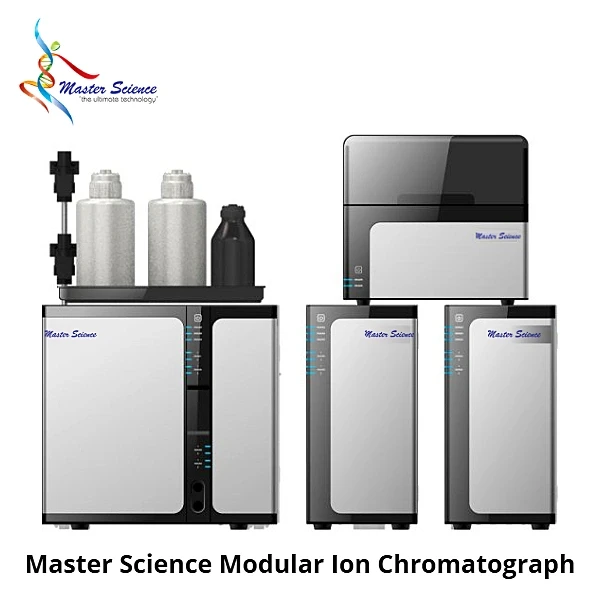
Modular Ion Chromatograph - Multifunctional IC System - Quaternary Pump 0.001-12 mL/min - 40 MPa
Inhouse product


The Master Science Modular Ion Chromatograph is a high-end, multifunctional IC series in which the pump, eluent generator, detector and post-column derivatisation unit are separate modules. Laboratories choose the combination that fits their methods and add to it later.
With conductivity, electrochemical and UV detectors it covers routine anions and cations as well as cyanide, iodide, sugars, small organic acids, hexavalent chromium and transition metals. Upgrades include post-column derivatisation, online concentration and online matrix elimination.
Technical Specifications
Specifications of the Master Science Modular Ion Chromatograph:
- Brand: Master Science
- Model Number: MSIC-W6600SWISS
- SKU: MSIC-W6600SWISS
- Brand: Master Science
- Model Number: MSIC-W6600SWISS
- SKU: MSIC-W6600SWISS
- Pump: Dual-plunger, all-PEEK head, isocratic or quaternary gradient
- Flow Rate: 0.001 to 12.000 mL/min
- Pump Pressure: 0 to 40 MPa
- Flow Setting Error / Stability: ≤0.1% / ≤0.1%
- Pressure Pulsation: <0.25%
- Eluent pH Range: 0 to 14
- Conductivity Baseline Noise: ≤0.0003 µS/cm
- Conductivity Baseline Drift: ≤0.001 µS/cm per 30 min
- Conductivity Range: 0 to 45000 µS/cm
- Conductivity Cell Volume: ≤0.4 µL
- Minimum Detection (conductivity): Cl⁻ ≤0.0001 µg/mL; Li⁺ ≤0.00005 µg/mL; NO₃⁻ ≤0.001 µg/mL; Na⁺ ≤0.001 µg/mL; Ca²⁺ ≤0.005 µg/mL
- Cell Temperature Control: Detector zone +5 °C to 65 °C; stability 0.05 °C/h
- Amperometric Output: Integral mode 50 pC to 200 µC; DC mode 1 pA to 74 µA
- Amperometric Noise: Integral <30 pC; DC <5 pA
- Minimum Detection (amperometric): I⁻ 0.001 µg/mL; fructose 0.01 µg/mL; CN⁻ 0.0005 µg/mL
- Suppressor: Electrolytically regenerated membrane; 0 to 500 mA; 170 µeq/min; dead volume 50 µL
- Column Oven: Air bath, room temperature +5 °C to 70 °C; stability ≤0.1 °C; 150 and 250 mm columns
- Eluent Generator: KOH or MSA, 0.1 to 100.0 mM; flow 0.001 to 3.000 mL/min; max 21 MPa
- Eluent Gradient Accuracy / Precision: 1.5% / 0.2%
- Temperature Zones: Five-zone control
Key Benefits
- One platform, many analytes: the Master Science Modular Ion Chromatograph accepts three detector types.
- Anions and cations together: single-needle injection for simultaneous analysis.
- Stable low-level results: conductivity noise at or below 0.0003 µS/cm.
- Longer suppressor life: current follows eluent concentration during gradients.
- Upgrade path: modules added as methods expand.
A compact alternative is the Master Science integrated ion chromatograph.
Product Features
Pump
- Servo DC motor for low noise and vibration
- Built-in quaternary proportioning valve
- Electronic pulsation suppression
- High and low pressure protection
Reagent-Free Operation
- Water-only eluent generator
- Hydroxide, carbonate and methanesulfonate generator types
- Gradient elution possible with an isocratic pump
Detection
- Plug-in conductivity and electrochemical detectors
- DC, pulsed and integrated pulsed amperometric modes
- Variable-wavelength UV with post-column derivatisation for transition metals and hexavalent chromium
- Coupling to other detection techniques
Software
- Graphical integrated control with real-time parameters
- Multi-channel thumbnails of pressure, temperature and chromatograms
- Audit trail covering acquisition, processing and reporting
- More than three levels of user permission
Applications
The Master Science Modular Ion Chromatograph is used for:
- Routine anion and cation analysis
- Cyanide and iodide determination
- Sugars and small organic acids
- Hexavalent chromium and transition metals
Optional Accessories
- 48-position autosampler, full-loop injection, 10 to 4000 µL, repeatability <0.5% RSD
- 120-position autosampler with 4 to 30 °C temperature control, repeatability <0.3% RSD, cross-contamination <0.01%
- Electrochemical and UV detectors
- Post-column derivatisation device
Common Problems and How This System Helps
How the Master Science Modular Ion Chromatograph extends laboratory capability:
- Separate instruments for different ion classes: one modular system with interchangeable detectors.
- Trace ions below detection limits: online concentration and low-noise detection.
- Matrix interference: online matrix elimination.
- Hard-to-trace data changes: audit trail and permission levels.
Frequently Bought Products
"Explore Master Science, your trusted provider of high-quality laboratory equipment and innovative solutions. Discover our extensive range of analytical instruments and exceptional customer support, all dedicated to empowering scientific discovery across industries. Join us in advancing research and setting new standards globally."


