


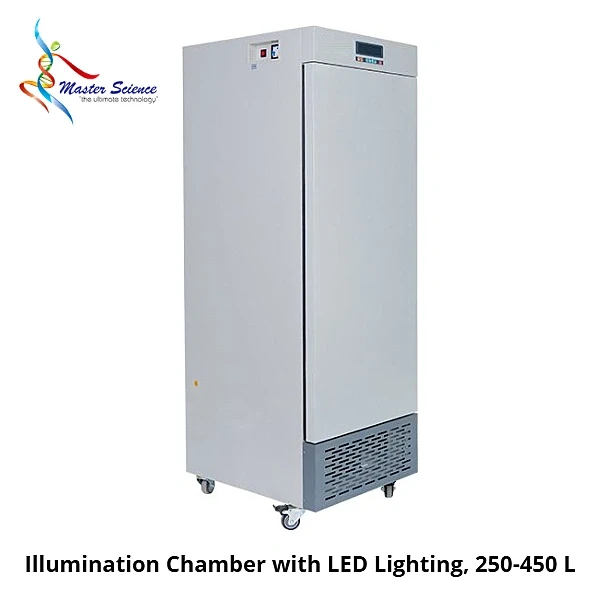
LED Illumination Chamber 250-450 L, Up to 20000 lx, 4 to 50°C, Plant Growth Chamber with Defrost
Inhouse product

The Master Science LED Illumination Chamber recreates light and temperature conditions for plants, seeds, insects and cell cultures. LED cold light reaches up to 12000, 15000 or 20000 lux depending on size and can be set in six steps, while the chamber holds 4 to 50°C without light or 10 to 50°C with the lights on.
Air is drawn in at the back and supplied from below by a large-impeller fan, and the shelves are laser-perforated so it flows evenly around the samples. A three-stage automatic defrost keeps ice from upsetting temperature during cold runs. The LCD controller handles fixed-value and timed running, with an optional program of 30 segments and 100 cycles for day-night cycles.
Technical Specifications
Specifications of the Master Science LED Illumination Chamber range:
- Brand: Master Science
- Model Number: MSICB-L250BSWISS,MSICB-L350BSWISS,MSICB-L450BSWISS
- SKU: MSICB-L250BSWISS,MSICB-L350BSWISS,MSICB-L450BSWISS
- Brand: Master Science
- Model: MSICB-L250BSWISS, MSICB-L350BSWISS, MSICB-L450BSWISS
- SKU: MSICB-L250BSWISS, MSICB-L350BSWISS, MSICB-L450BSWISS
- Capacity: 250 / 350 / 450 L
- Circulation: Forced convection
- Internal dimensions (W×D×H): 560 × 420 × 1050 / 560 × 530 × 1200 / 700 × 520 × 1210 mm
- External dimensions (W×D×H): 660 × 660 × 1700 / 670 × 730 × 1880 / 810 × 790 × 1890 mm
- Temperature range: With lighting 10-50°C; without lighting 4-50°C
- Fluctuation: ±1°C
- Resolution: 0.1°C
- Uniformity: ±1 / ±2 / ±2°C
- Sensor: PT100
- Illumination: 0-12000 / 0-15000 / 0-20000 lx
- Illumination control: 6-level relative illuminance
- Controller: PID
- Display: Large LCD
- Timer: 1-9999 min (optional 30 segments × 100 cycles)
- Chamber: Brushed stainless steel
- Exterior: Electrostatically coated cold-rolled steel
- Shelves: 3, adjustable, perforated
- Refrigerant: R134a (CFC free)
- Defrost: Automatic
- Safety: Over-temperature sound and light alarm; leakage protector; self-diagnosis
- Power supply: AC 220/110 V, 50/60 Hz
- Power consumption: 1500 / 2150 / 2250 W
- Net / gross weight: 103/123, 128/149, 153/175 kg
Key Benefits
- Strong, adjustable light: The Master Science LED Illumination Chamber delivers up to 20000 lux in six selectable levels.
- Stable at low temperature: Automatic three-stage defrost prevents frost-related drift.
- Even conditions on every shelf: Back-suction, bottom-supply airflow and perforated shelves.
- Simulate day and night: Optional 30-segment programs vary light and temperature over time.
For a lower-intensity option, see our LED illumination incubator up to 6000 lx alongside the Master Science LED Illumination Chamber.
Product Features
Lighting and climate
- LED cold light, 6 brightness levels
- 4-50°C range, 10-50°C with lights on
- Three-stage electric defrost program
Control
- Large LCD with screen lock
- Fixed-value and timed running with end alert
- Optional 30-segment × 100-cycle program
- Self-diagnosis with fault display
Construction
- Brushed stainless steel chamber
- Laser-perforated, adjustable shelves (30 mm minimum spacing)
- Waterproof stainless steel heater
- Leakage protection
Applications
The Master Science LED Illumination Chamber is used for:
- Seed germination and seedling tests
- Plant cultivation and breeding
- Microbial, tissue and cell culture
- Rearing insects and small animals
- Environmental and climate simulation studies
Standard Accessories Included
- LED illumination chamber
- Shelves ×3
Optional Accessories
- Test port Ø25, 50 or 80 mm
- Internal socket
- Digital independent temperature limiter
- Programmable controller with USB, RS485/232 or built-in printer
- Spare shelf
- Observation window
Growth Study Problems the Master Science LED Illumination Chamber Solves
Window sills and greenhouses give unpredictable conditions. The Master Science LED Illumination Chamber addresses:
- Inconsistent light levels: LED lighting is set in fixed, repeatable steps.
- Temperature swings in cold runs: Automatic defrost keeps the chamber steady.
- Uneven growth between shelves: Engineered airflow evens out temperature.
- Manual day-night switching: Programs automate light and temperature cycles.
Frequently Bought Products
"Explore Master Science, your trusted provider of high-quality laboratory equipment and innovative solutions. Discover our extensive range of analytical instruments and exceptional customer support, all dedicated to empowering scientific discovery across industries. Join us in advancing research and setting new standards globally."


