


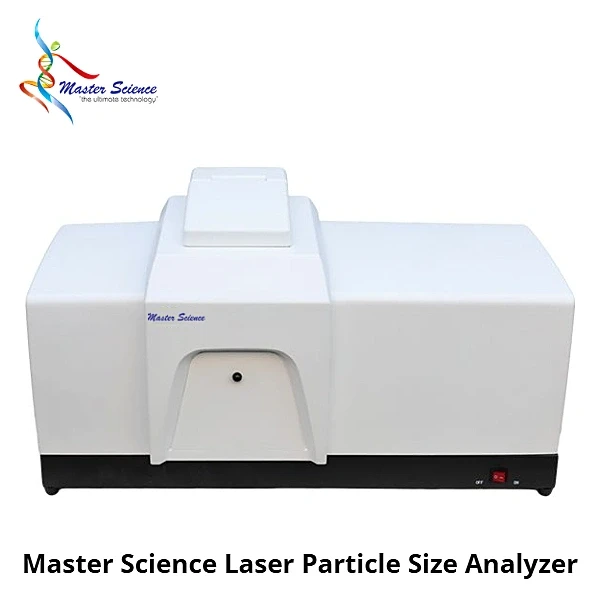
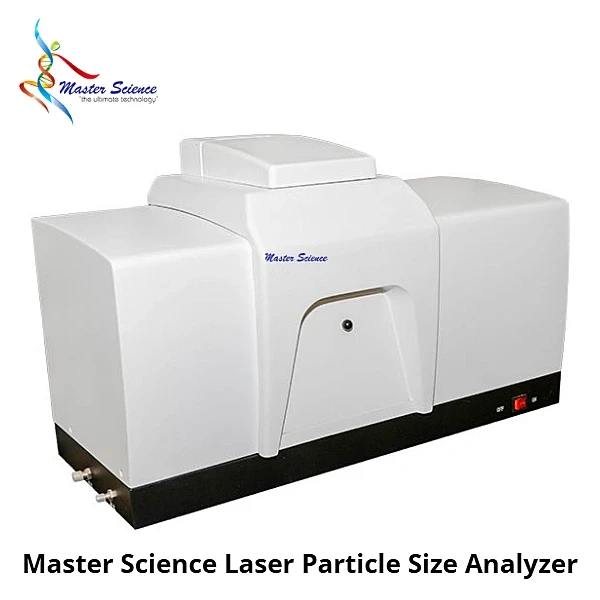
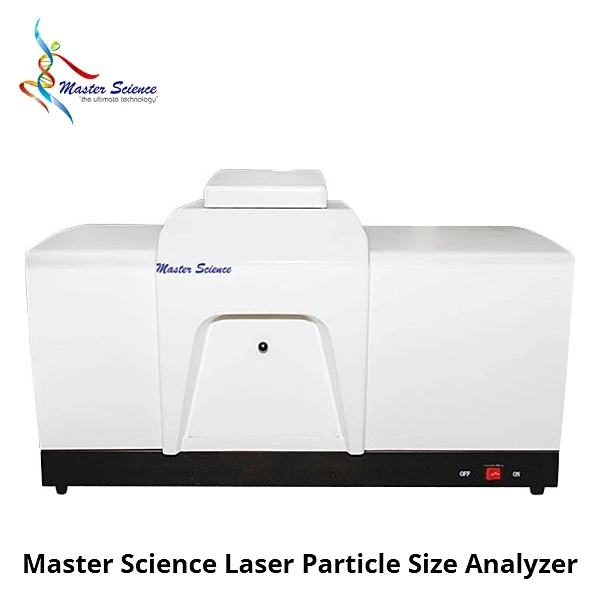
Laser Particle Size Analyzer - Wet and Dry Laser Diffraction System - 0.01-1000 μm, ≤0.5% Accuracy
Inhouse product


The Master Science Laser Particle Size Analyzer measures particle size distribution by laser diffraction, using a highly sensitive annular photoelectric detector to raise test precision. Its unconstrained free-fitting calculation reports the distribution as it really is, which makes the instrument especially suitable for materials with a narrow size distribution.
The range has three wet-dispersion versions and one dry-dispersion version, covering from 0.01 μm up to 1000 μm depending on model. Every Master Science Laser Particle Size Analyzer offers both manual and fully automatic operation, plus motorised alignment of the optical path.
Technical Specifications
Specifications for the four versions of the Master Science Laser Particle Size Analyzer are given below.
- Brand: Master Science
- Model Number: MSPSA-LA2600ASWISS, MSPSA-LA2600BSWISS, MSPSA-LA2018SWISS, MSPSA-LD3003ASWISS
- SKU: MSPSA-LA2600ASWISS, MSPSA-LA2600BSWISS, MSPSA-LA2018SWISS, MSPSA-LD3003ASWISS
- Instrument Type: Wet (MSPSA-LA2600ASWISS, MSPSA-LA2600BSWISS, MSPSA-LA2018SWISS); Dry (MSPSA-LD3003ASWISS)
- Measuring Range: 0.01 to 1000 μm (MSPSA-LA2600ASWISS); 0.1 to 1000 μm (MSPSA-LA2600BSWISS); 0.1 to 450 μm (MSPSA-LA2018SWISS); 0.1 to 300 μm (MSPSA-LD3003ASWISS)
- Photodetector Elements: 87 (MSPSA-LA2600ASWISS); 87 (MSPSA-LA2600BSWISS); 40 (MSPSA-LA2018SWISS); 40 (MSPSA-LD3003ASWISS)
- Accuracy (CRM D50): ≤0.5% (MSPSA-LA2600ASWISS); ≤1% (MSPSA-LA2600BSWISS); ≤1% (MSPSA-LA2018SWISS); ≤0.5% (MSPSA-LD3003ASWISS)
- Repeatability (CRM D50): ≤0.5% (MSPSA-LA2600ASWISS); ≤1% (MSPSA-LA2600BSWISS); ≤1% (MSPSA-LA2018SWISS); ≤0.5% (MSPSA-LD3003ASWISS)
- Design Principle: Laser diffraction
- Analysis Principle: Mie scattering, Fraunhofer diffraction
- Laser: Main fibre laser 639 nm, P>2 mW, with auxiliary laser 405 nm, P>2 mW (MSPSA-LA2600ASWISS); Fibre laser 639 nm, P>2 mW (MSPSA-LA2600BSWISS); Semiconductor laser 635 nm, P>2 mW (MSPSA-LA2018SWISS); Laser 632.8 nm, P>2 mW (MSPSA-LD3003ASWISS)
- Laser Safety: Class 1
- Operation Mode: Full automatic, manual control
- Optical Alignment: Full automatic
- Test Speed: ≤2 min, typical testing time ≤10 s (MSPSA-LA2600ASWISS); ≤2 min, typical testing time ≤10 s (MSPSA-LA2600BSWISS); ≤2 min, typical testing time ≤15 s (MSPSA-LA2018SWISS); ≤1 min (MSPSA-LD3003ASWISS)
- Ultrasonic (wet versions): Frequency 40 kHz, power 60 W, time ≥1 s
- Stirrer (wet versions): 0 to 3000 rpm, adjustable
- Circulation (wet versions): Rated flow 3-8 L/min, rated power 15 W (MSPSA-LA2600ASWISS); rated flow 8 L/min, rated power 10 W (MSPSA-LA2600BSWISS, MSPSA-LA2018SWISS)
- Sample Tank (wet versions): 450 mL (MSPSA-LA2600ASWISS, MSPSA-LA2600BSWISS); 350 mL (MSPSA-LA2018SWISS)
- Dry Dispersion (MSPSA-LD3003ASWISS): Dry-turbulence dispersion mode, normal shock wave shear technique
- Sample Feeding (MSPSA-LD3003ASWISS): Automatic sampler (SOP setting)
- Dispersion Medium (MSPSA-LD3003ASWISS): Compressed air
- Connect to PC, LIMS: Yes
- Test Report: Word, Excel, image, text and other formats
- Working Environment: 5 to 35°C, humidity <85%
- Storage Environment: -20 to 50°C
- Power Supply: 220 V, 50/60 Hz
- Product Dimensions (L x W x H): 850 x 390 x 450 mm (MSPSA-LA2600ASWISS); 850 x 390 x 450 mm (MSPSA-LA2600BSWISS); 780 x 365 x 495 mm (MSPSA-LA2018SWISS); 765 x 450 x 325 mm and 260 x 285 x 135 mm (MSPSA-LD3003ASWISS)
- Net Weight: 40 kg (MSPSA-LA2600ASWISS); 40 kg (MSPSA-LA2600BSWISS); 40 kg (MSPSA-LA2018SWISS); 26 kg and 7 kg (MSPSA-LD3003ASWISS)
Key Benefits
- Wet or dry, one family:: the Master Science Laser Particle Size Analyzer range covers both dispersion methods.
- Quick turnaround:: a full automatic wet cycle takes less than 2 minutes.
- No manual optics tuning:: four stepping motors align the light path.
- True distribution shape:: free-fitting analysis is not tied to a fixed model.
- Representative sampling:: built-in stirring, ultrasonic and circulation.
For nanoparticle sizing below the diffraction range, see the Master Science zeta potential and nanoparticle size analyzer.
Product Features
Operation and Speed
- Manual and automatic modes: run a preliminary test manually, then switch to automatic for routine work
- Wet dispersion in automatic mode handles water supply, ultrasonic dispersion, stirring, circulation, background calibration, testing, data analysis, drainage and cleaning
- Dry dispersion supports one-key testing with automatic dust collection, air supply and feeding
Optics
- Converging-light Fourier transform optical path frees large-angle scattered light from the limits of the lens aperture
- Annular multi-element silicon photodiode collects the particle light signals for higher resolution
- Automatic alignment with four hybrid stepping motors and 0.1 μm micro-precision
Sample Dispersion
- Fully built-in wet system combining mechanical stirring, ultrasonic dispersion and circulation
- Avoids uneven distribution and settling of large particles caused by long external pipelines
- Dry system uses turbulent dispersion and normal shock shearing for thorough dispersion
Software
- Analysis modes: free distribution, R-R distribution, log-normal distribution, mesh size classification and more
- Statistical methods: volume distribution and quantity distribution
- Statistical comparison of multiple results, such as different batches or before and after processing
- User-defined analysis: percentage from particle size, particle size from percentage, percentage within a size range
Applications
The Master Science Laser Particle Size Analyzer is used for particle size testing and quality control of materials such as:
- Industrial raw material powders
- Samples before and after milling or processing
- Batch-to-batch comparison in production
- Materials with a narrow particle size distribution
Optional Accessories
- Micro-sample cuvette (wet versions)
- Audit trail software
Common Problems This Analyzer Solves
Particle sizing often suffers from the same handful of difficulties.
- Optical path drifts out of alignment:: motorised automatic alignment keeps it at its best.
- Large particles settle before they are measured:: the built-in dispersion loop keeps the path short.
- Operator-to-operator differences:: automatic mode runs every step the same way each time.
- Fixed distribution models distort results:: free-fitting analysis follows the measured data.
Frequently Bought Products
"Explore Master Science, your trusted provider of high-quality laboratory equipment and innovative solutions. Discover our extensive range of analytical instruments and exceptional customer support, all dedicated to empowering scientific discovery across industries. Join us in advancing research and setting new standards globally."


