


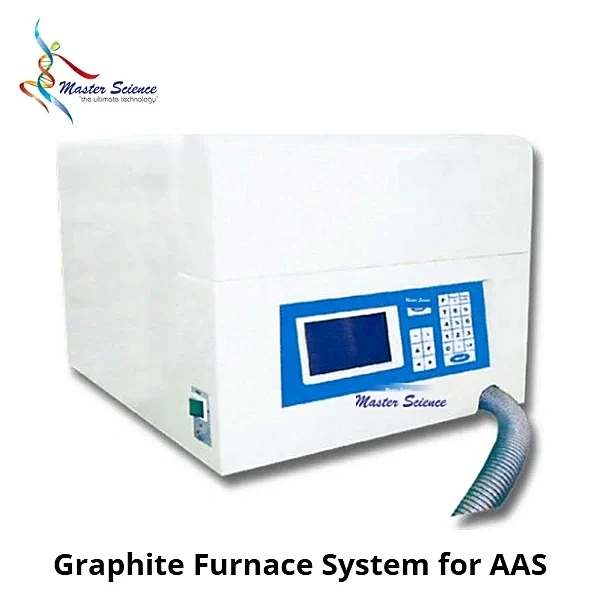
Graphite Furnace System - AAS Graphite Atomizer - 20-3000°C Range - 9 Heating Steps
Inhouse product


The Master Science Graphite Furnace System is an electrothermal atomizer for quantitative trace element analysis by graphite furnace atomic absorption. Connected to a compatible atomic absorption spectrophotometer, it lowers detection limits well below flame AAS, reaching picogram levels for elements such as cadmium.
A nine-step temperature program from ambient to 3000 °C, with adjustable ramp and hold times, lets each method dry, ash and atomize the sample under controlled conditions.
Technical Specifications
Technical data of the Master Science Graphite Furnace System:
- Brand: Master Science
- Model Number: MSGRD-3202SWISS
- SKU: MSGRD-3202SWISS
- Heating Steps: 9
- Temperature Range: 20 °C to 3000 °C (nominal)
- Ramp Time: 0 to 999 s
- Hold Time: 1 to 999 s (ramp + hold ≤ 999 s)
- High-power Heating: 1000 °C to 2700 °C
- Inert Gas: Argon, inlet pressure above 0.3 MPa
- Cooling Water: Tap or recirculated water, at least 2 L/min
- Display: LCD
- Interfaces: AAS spectrophotometer, autosampler, RS232
- Alarms: Gas pressure and furnace overheat
- Characteristic Mass (with AAS): Cd ≤ 1 × 10⁻¹² g; Cu ≤ 1 × 10⁻¹⁰ g
- Power Supply: 220 V ±22 V, 50 Hz ±1 Hz (3 A control; 30 A heating)
- Heating Power: About 5.1 kW at 2700 °C
- Rated Power: 7.2 kW
- Operating Conditions: +10 °C to +30 °C; humidity below 85 %
- Package Dimensions (W × D × H): 730 × 660 × 910 mm
Key Benefits
- Lower detection limits: the Master Science Graphite Furnace System atomizes the whole sample in the tube, reaching picogram levels for trace metals.
- Method flexibility: nine programmable steps with independent ramp and hold times suit dry, ash and atomize stages for different matrices.
- Protected operation: alarms warn of low argon pressure or furnace overheating before damage occurs.
- Easy integration: RS232 and autosampler interfaces connect the furnace to the AAS workflow.
- Small sample volumes: furnace analysis needs far less sample than flame aspiration.
The furnace is designed as an accessory for the Master Science double beam flame AAS analyzer.
Product Features
Temperature Program
- Ambient to 3000 °C nominal range
- Nine heating steps
- Ramp 0 to 999 s and hold 1 to 999 s per step
- High-power heating mode from 1000 °C to 2700 °C
Safety and Utilities
- Argon purge for tube protection
- Water cooling at 2 L/min or more
- Gas pressure and overheat alarms
Connectivity
- Interface to atomic absorption spectrophotometer
- Autosampler connection
- RS232 output and LCD display
Applications
The Master Science Graphite Furnace System is used for trace analysis of:
- Lead, cadmium and other heavy metals in drinking water
- Toxic elements in food and biological samples
- Trace metals in soil and environmental samples
- Impurities in pharmaceutical and high-purity materials
- Research on low-level elemental contamination
Common Laboratory Problems and How This Furnace Helps
Typical trace metal challenges addressed by the Master Science Graphite Furnace System:
- Flame AAS not sensitive enough: furnace atomization reaches far lower concentrations.
- Limited sample volume: microlitre injections are enough for analysis.
- Matrix interference: separate drying and ashing steps remove the matrix before atomization.
- Equipment damage from utility failure: gas and overheat alarms protect the furnace.
- Manual sample injection: an autosampler interface supports unattended runs.
Frequently Bought Products
"Explore Master Science, your trusted provider of high-quality laboratory equipment and innovative solutions. Discover our extensive range of analytical instruments and exceptional customer support, all dedicated to empowering scientific discovery across industries. Join us in advancing research and setting new standards globally."


